
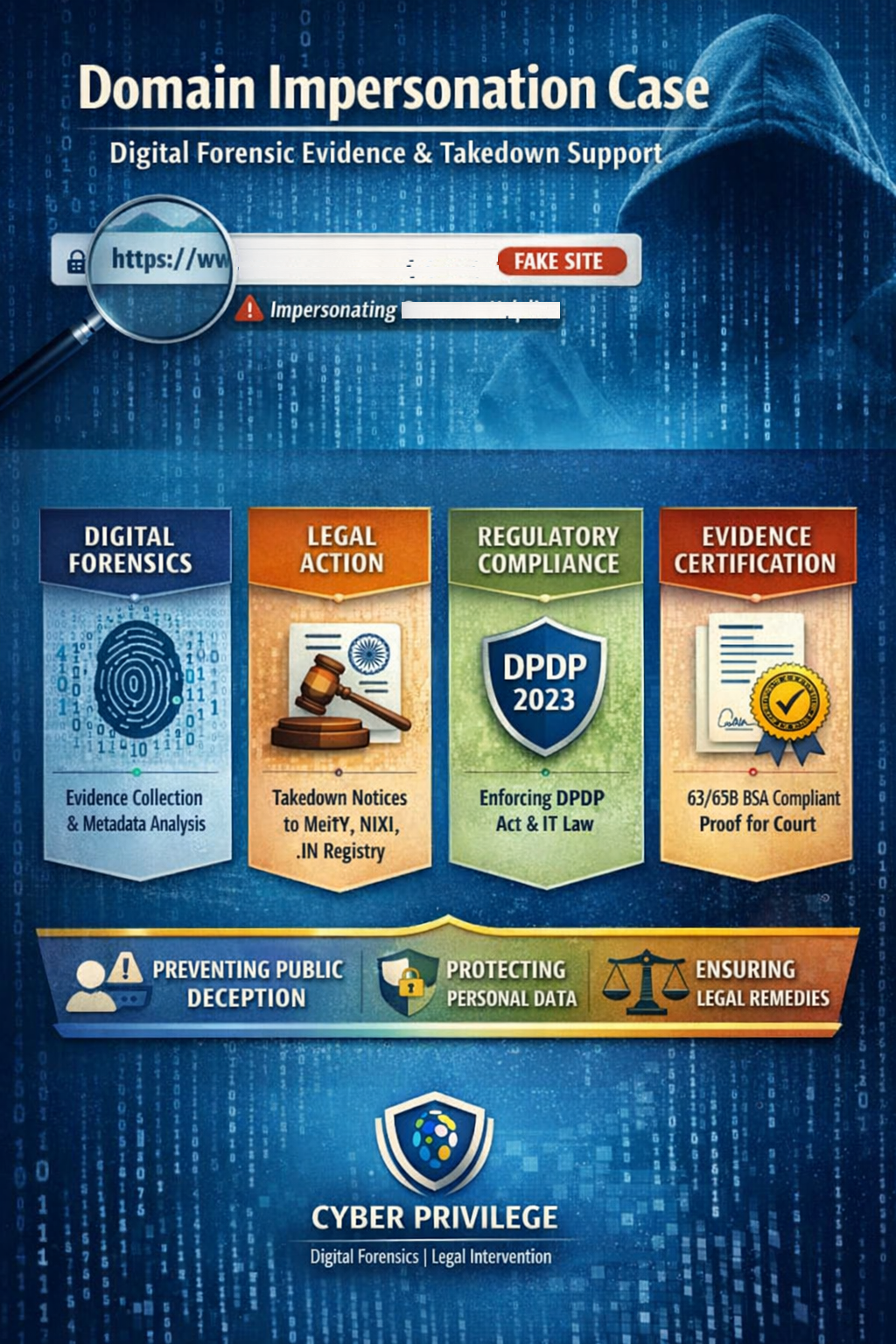
Domain Impersonation Case – Digital Forensic Evidence & Takedown Support
₹55000.00₹40100.00
Domain Impersonation Case – Digital Forensic Evidence & Takedown Support
A Comprehensive Technical, Legal, and Forensic Framework
🔍 1. Understanding Domain Impersonation (Threat Landscape)
Domain impersonation refers to the deliberate registration and operation of deceptive domains that closely resemble legitimate platforms—often government portals, financial institutions, or established brands—with the intent to:
Mislead users through visual similarity and keyword manipulation
Collect sensitive personal or financial data (phishing / social engineering)
Publish defamatory or misleading content
Divert legitimate traffic for fraudulent gain
Undermine public trust in official systems
From a cyber forensic perspective, such domains typically exhibit:
Typosquatting / lookalike naming patterns
Misuse of SSL certificates to create false legitimacy
Hosting on offshore or privacy-protected infrastructure
Integration with data harvesting forms or redirection chains
⚖️ 2. Legal & Regulatory Violations Involved
Domain impersonation cases intersect multiple legal frameworks:
A. Digital Personal Data Protection Act, 2023 (DPDP Act)
Unauthorized collection and processing of personal data
Absence of lawful consent mechanisms
Violation of purpose limitation & data minimization principles
B. Information Technology Act, 2000 & IT Rules
Section 66: Computer-related offences (fraudulent access, misuse)
Section 66C/66D: Identity theft & cheating by impersonation
Intermediary Guidelines: Failure of due diligence by hosting providers
C. Bharatiya Nyaya Sanhita (BNS), 2023
Criminal impersonation
Fraud and cheating
Public deception affecting trust in institutions
D. Bharatiya Sakshya Adhiniyam (BSA), 2023
Governs admissibility of electronic evidence (Sections 63 & 65B equivalent)
Requires proper certification and forensic integrity
E. International Regulations (if applicable)
GDPR: Cross-border data misuse and unlawful processing
ICANN & Domain Dispute Policies (UDRP)
🧪 3. Digital Forensic Investigation Methodology
A structured forensic workflow is critical to ensure evidence admissibility and legal strength:
Stage 1: Evidence Identification
Detection of impersonation indicators
URL structure, branding similarity, content duplication
Identification of victim impact (data capture, defamation, fraud)
Stage 2: Evidence Acquisition
Secure capture of:
Webpage content (HTML, scripts, UI elements)
Network logs and DNS resolution data
WHOIS records and registrar details
Use of forensically sound tools ensuring no data alteration
Stage 3: Metadata & Infrastructure Analysis
Server location tracing (geo-IP mapping)
Hosting provider and CDN identification
Historical domain records (passive DNS, archival snapshots)
SSL/TLS certificate inspection
Stage 4: Attribution & Link Analysis
Identifying connections between:
Multiple domains (fraud networks)
Email IDs, payment gateways, or contact details
Behavioral analysis of threat actors
Stage 5: Documentation & Reporting
Detailed forensic report including:
Technical findings
Screenshots with hash validation
Timeline reconstruction
Preparation of court-admissible evidence documentation
📜 4. Digital Evidence Certification (Legal Admissibility)
For any cyber case to sustain in court, evidence must comply with statutory requirements:
Issuance of Section 63 / 65B (BSA 2023 compliant) Digital Evidence Certificate
Inclusion of:
Device and tool details used for capture
Hash values (integrity verification)
Methodology declaration
Certification by a qualified Cyber Forensic Expert
This transforms raw digital data into legally enforceable evidence.
🚨 5. Takedown & Enforcement Strategy
A multi-layered escalation approach is adopted:
A. Registrar & Registry Escalation
Filing complaints to domain registrar and national registry
Demonstrating:
Bad faith registration
Trademark / identity infringement
Public harm potential
B. Government & Regulatory Authorities
Escalation to relevant ministries and cyber authorities
Submission of forensic evidence to support action
C. Hosting & Infrastructure Providers
Abuse reports to hosting providers/CDNs
Request for content suspension or server shutdown
D. Legal Notices
Drafting formal notices citing:
Applicable cyber laws
Data protection violations
Criminal liabilities
⚠️ 6. Challenges in Domain Takedown
Despite strong evidence, practical barriers often arise:
Jurisdictional limitations (foreign hosting/registrars)
Delays due to bureaucratic processing in registries
Lack of immediate enforcement under evolving DPDP framework
Use of privacy protection services masking registrant identity
This necessitates persistent escalation, multi-agency coordination, and legally robust documentation.
🛡️ 7. Risk Impact Assessment
Domain impersonation can result in:
Reputational Damage – Loss of public trust
Financial Loss – Fraudulent transactions or business diversion
Legal Exposure – Liability if users are misled
Data Breach Risks – Unauthorized harvesting of personal data
🔄 8. Preventive & Strategic Measures
To mitigate future risks:
Continuous domain monitoring & threat intelligence
Defensive domain registration (similar domain variants)
Implementation of DMARC, SPF, DKIM for email security
Public awareness and official communication clarity
Rapid incident response protocols
🤝 9. Role of Cyber Forensic Experts
A specialized agency provides:
Technical expertise in evidence acquisition & analysis
Legal alignment ensuring admissibility in court
Strategic escalation to authorities and intermediaries
Advisory support for litigation and compliance
📌 Conclusion
Domain impersonation is not merely a technical anomaly—it is a multi-dimensional cyber offence involving fraud, identity misuse, and data protection violations. Addressing it requires:
Precision-driven digital forensic investigation
Legally compliant evidence certification
Aggressive and structured takedown strategy
A well-executed approach ensures:
✔ Protection of public trust
✔ Safeguarding of personal data
✔ Strong legal positioning for enforcement and prosecution